
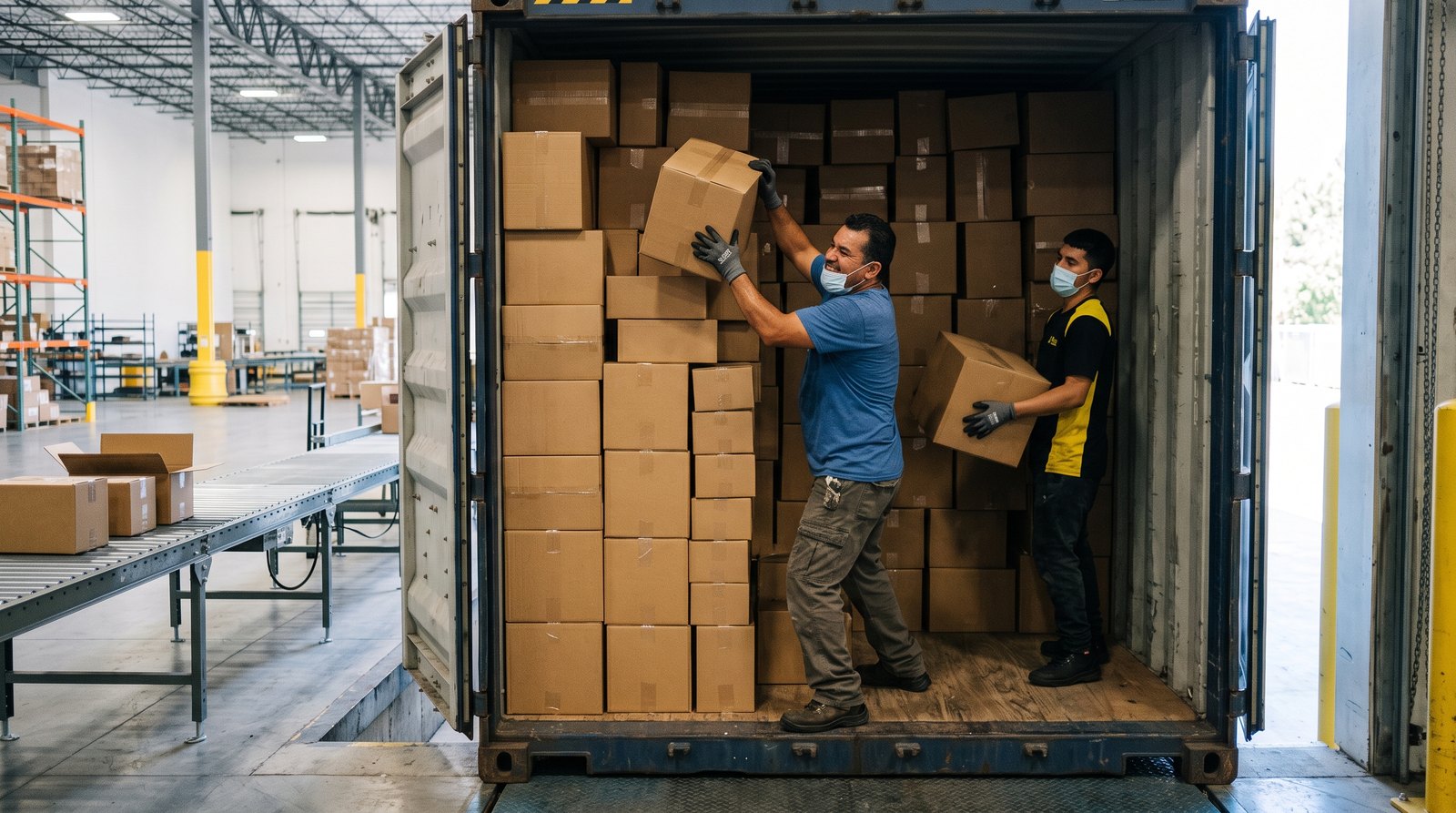
Container unloading (often called “devanning” or “unstuffing”) can look simple on paper, but the total cost changes quickly based on how the freight is loaded, how many touches it needs, and how predictable your outbound plan is. This guide explains the cost drivers that matter most - especially the difference between floor-loaded and palletized containers - and how to request a quote that won’t get reworked later.
If you’re mapping a complete handling workflow in the Denver area (cross-dock + staging + recovery options), start here. Services
What drives the cost of unloading a container or floor-loaded trailer?
The biggest cost drivers are labor time, touch count, and complexity. The more your unload looks like “move pallets with a forklift,” the more predictable it becomes. The more it looks like “hand unload cartons, sort, count, and rebuild pallets,” the more the scope (and price) expands.
In most operations, cost increases when:
- Freight is floor-loaded (manual handling) rather than palletized
- The unload requires sorting/splitting for multiple outbound destinations
- Pallets are unstable, damaged, or non-standard and need rewrap/repalletizing
- Documentation is unclear (so verification and recounting becomes part of the job)
Is floor-loaded cheaper than palletized once you include unloading labor?
Sometimes, but not always. Floor-loading can reduce packaging and pallet material cost and can maximize container cube, but it often increases unloading labor and time. Palletized freight usually unloads faster with equipment, but you may pay for pallets, palletizing, and sometimes lower cube utilization.
A practical way to decide is to compare total cost across the entire move: materials + time + downstream exception risk.
Decision table: how floor-loaded and palletized freight change unloading cost
| Cost factor | Floor-loaded container | Palletized container | Why it changes the price |
|---|---|---|---|
| Unloading method | Manual/hand unload is common | Forklift/pallet jack unload is common | Floor-loaded tends to be more labor-intensive; palletized tends to be more predictable |
| Time at dock | Longer (more individual touches) | Shorter (pallet moves) | Longer dock time increases labor and scheduling friction |
| Sorting needs | Often higher (mixed cartons) | Often lower if pallets are destination-ready | Sorting and splitting adds touches and scope |
| Damage/exception exposure | Packaging may be less protected; higher handling touches | Pallets provide structure, but bad builds create instability | Exceptions can add rewrap/repalletize work |
| Equipment dependency | Less dependent (still may need carts/lines) | More dependent (forklift, pallet jack, dock plates) | Equipment constraints can create delays or require alternative labor |
What’s typically included in a container unloading service - and what becomes an add-on?
A basic unload usually includes removing freight from the container and staging it in an agreed area. Add-ons appear when the work goes beyond “remove and stage” into “process and rebuild.”
Typically included (basic scope):
- Open container and unload freight
- Stage freight in a designated area (short, controlled staging)
- Basic count by pallet (for palletized loads) or by obvious unit groupings
Common add-ons (scope expanders):
- Hand unload + pallet building (common for floor-loaded freight)
- Detailed counting/verification by SKU or carton
- Sorting/splitting into multiple outbound groups
- Labeling/relabeling
- Rewrap, restack, or repalletize when freight is unstable
- Extended dwell time beyond brief staging
If your plan is to transfer freight from inbound to outbound quickly, cross-docking is usually the cleanest workflow to keep scope bounded.
How do you estimate unloading time without guessing?
You can’t predict exact minutes for every container, but you can estimate confidently by identifying which “time multipliers” apply.
Time tends to increase when:
- The container is floor-loaded with mixed cartons
- Cartons are heavy/awkward or require careful handling
- You need destination sorting during the unload
- Pallet-building rules are strict (height limits, SKU separation, corner boards, etc.)
- The inbound load has visible instability (leaning stacks, torn wrap, crushed packaging)
If you want the quote to stay stable, define two things upfront:
- Your scope boundary (what’s included vs what triggers add-ons)
- Your exception plan (what to do if the freight arrives unstable or mismatched)
What information should you send for an accurate container unloading quote (checklist)?
Send enough information for the facility to estimate touch count, labor time, and downstream handling. The goal is to eliminate “unknowns” that force re-quotes.
Container unloading quote checklist:
- Container type (20’/40’, standard vs high-cube) and arrival window
- Load type: floor-loaded vs palletized (include photos if possible)
- Commodity and packaging (cartons, cases, bags, odd shapes)
- Estimated quantities: cartons/cases and/or expected pallet count after build
- Weight notes (heavy cartons, team-lift needs, fragile goods)
- Pallet rules if building pallets (max height, SKU separation, pallet type)
- Outbound plan: number of outbound trailers/destinations and timing
- Verification needs: simple count vs SKU/carton-level count
- Staging expectations: “same shift transfer” vs “short hold”
- Point of contact who can approve add-ons fast if scope changes
If you want a predictable handling plan when containers arrive with mixed freight, build the workflow from the service overview first.
When does container unloading turn into cross-docking or rework (and why does cost change)?
It turns into cross-docking when the unload is part of a planned inbound-to-outbound transfer with minimal dwell. It turns into rework when the freight needs stabilization or “fixes” before it can safely ship onward.
Cost changes because the job shifts from “unload and stage” to “process and correct.” If you routinely deal with unstable pallets or rejected freight, having a defined rework option keeps costs controlled when exceptions happen.
Two real-world scenarios: what makes container unloading expensive (and what prevents it)
Scenario 1: Floor-loaded 40’ container with mixed SKUs and no outbound grouping
A shipment arrives floor-loaded with mixed cartons and multiple SKU families. The outbound plan isn’t finalized, so the unload team has to stage everything and then re-handle cartons to build destination-ready pallets later. The scope expands from “unload” to “unload + sort + build pallets + verify,” which increases labor time.
What prevents it: sending a destination plan (even a draft) and defining whether the job includes pallet building and SKU-level verification.
Scenario 2: Palletized container with unstable builds and overhang
A palletized container unloads quickly - until several pallets show overhang and instability. The facility has to rewrap and restack to make the load safe for outbound shipping. The base unload stays reasonable, but the exception handling adds an extra work layer.
What prevents it: clearer pallet build standards upstream and sending “problem pallet” photos so the quote can include a defined exception process.
Common mistakes and red flags that lead to surprise totals
Most surprises come from unclear scope and missing outbound details.
Common mistakes:
- Asking for “unload only” without clarifying whether pallets must be built, sorted, or verified
- Not stating floor-loaded vs palletized (the biggest scope driver)
- Omitting outbound plan (destinations, trailers, appointment windows)
- Treating counting/verification as “minor” when it’s a major labor driver
- No single approver available when exceptions happen
Red flags to tighten before you book:
- Mixed freight with unclear labeling
- High likelihood of last-minute destination changes
- Visible instability (torn wrap, leaning stacks, crushed packaging)
- Unclear rules for pallet building (height limits, SKU separation, pallet type)
When a rail container cannot get into the plant on time, see rail container devanning for Commerce City overflow.
Frequently Asked Questions
What is “devanning”?
Devanning is the process of unloading cargo from a container (also called unstuffing or stripping). It typically happens at a warehouse, cross-dock, or distribution facility.
Do I need a forklift to unload a palletized container?
Often yes, or at least a pallet jack and suitable dock equipment. Equipment and dock conditions affect both speed and safety; confirm requirements before scheduling.
Can a cross-dock handle floor-loaded freight?
Yes, but it usually requires more labor and a clear scope (hand unload, pallet building, sorting). If the freight is mixed or unstable, defining exception handling upfront keeps costs predictable.
External references
- OSHA loading dock guidance for powered industrial trucks.
- OSHA powered industrial trucks standard (29 CFR 1910.178).
- FHWA freight glossary (general terminology reference).
< Older Post
Newer Post >
More in Pricing & accessorials
Keep reading in this cluster
How Long Can Freight Sit at a Denver Cross-Dock Before Storage Charges Start?
Most cross-docks allow a free dwell window measured in hours or a day or two, after which freight converts to storage billing. Here is how the clock works and how to keep freight from crossing the line.
How to Avoid Surprise Cross-Dock Fees: Scope Control, Quote Inputs, and a Simple Audit Workflow
Prevent surprise cross-docking add-ons with a scope-control playbook: what is included vs add-ons, a quote checklist, real scenarios, and a 5-step invoice audit workflow.
Cross-Docking Rates Explained: Per Pallet vs Per Load vs Hourly (and What Changes the Total)
Learn how cross-docking is priced (per pallet, per load, hourly, hybrid), what is usually included, and how to request a quote that avoids re-quotes.
Layover vs Detention in Freight: What Triggers Each Charge (and How to Prevent Both)
Understand layover vs detention in trucking, when detention becomes layover, what proof matters, and practical checklists to prevent surprise time-based charges.