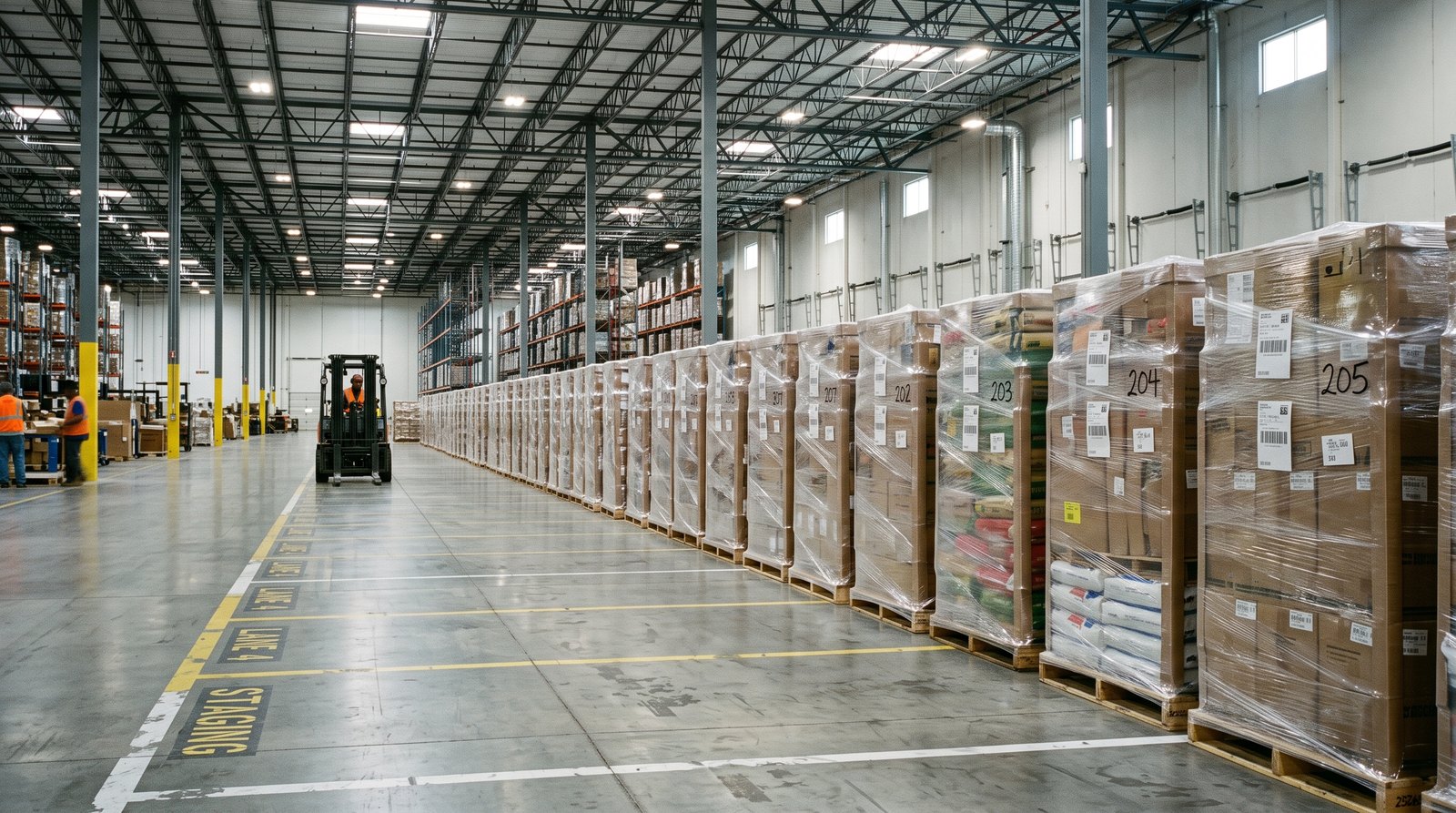
Cross-docking is designed for speed: freight comes in, gets transferred, and goes back out with little or no storage time. Pricing varies widely by facility and situation, but the underlying rate models are consistent - per pallet, per load, hourly labor, or a hybrid line-item quote. This guide helps you understand what those models mean, what’s usually included, and how to request a quote that doesn’t get reworked later.
If you’re planning a full Denver-area workflow (cross-dock + staging + recovery options), start here: Services
What does a cross-docking rate usually cover (and what is billed separately)?
A cross-docking rate usually covers moving freight from an inbound trailer to an outbound trailer with minimal dwell time. In most facilities, the base charge covers the “core moves,” while anything that adds touches, time, or complexity is billed as an add-on.
Commonly included in a base cross-dock:
- Inbound unload (pallets/cases off the inbound trailer)
- Short staging in a lane (brief hold while outbound is positioned)
- Outbound load (pallets/cases onto the outbound trailer)
Commonly billed separately (because they change labor/time):
- Sorting or splitting freight across multiple outbound destinations
- Re-stacking, re-wrap, or pallet rebuilding (stability fixes)
- Counting/verification beyond a simple count
- Labeling/relabeling or compliance checks
- Extended dwell (storage beyond “brief staging”)
A simple way to think about it: the more your cross-dock operation looks like handling + light warehouse work, the more a facility will price it with a hybrid model.
How are cross-docking services priced: per pallet, per load, or hourly?
Cross-docking is priced in a few standard ways. The “best” model depends on how predictable your freight is and how much exception handling you expect.
Per pallet pricing
Per pallet pricing charges a fixed amount per pallet handled through the facility (often applied to inbound + outbound moves). It works best when pallets are standard, counts are reliable, and the operation is straightforward.
Flat fee per load
Per load pricing charges a flat fee for moving a full truckload or a defined shipment through the cross-dock. It’s best when your loads are consistent and don’t require a lot of sorting or special handling.
Hourly labor pricing
Hourly pricing charges for the labor time required (and sometimes equipment time) to complete the work. It’s common when freight is mixed, irregular, or likely to need extra touches.
Hybrid (line-item) pricing
A hybrid quote combines a base move charge with add-ons (sorting, rework touches, short-term staging). It’s often the most accurate when your freight varies week to week.
Which pricing model fits your shipment best?
The right model is the one that matches your operational reality - especially how consistent your pallet builds and documentation are.
| Rate model | Best fit | Where costs creep in | Question to ask before booking |
|---|---|---|---|
| Per pallet | Standard palletized freight, reliable pallet count, minimal sorting | You may be charged per move (inbound + outbound) or per touch; non-standard pallets can change pricing | Is this per pallet per move (unload + load), and what counts as a pallet? |
| Per load (flat fee) | Full loads are similar each time and require minimal exceptions | Sorting, split destinations, or unstable pallets often break the flat-fee assumption | What conditions trigger add-ons or a re-quote? |
| Hourly | Mixed freight, irregular pallets, or frequent exceptions | Without a scope boundary, hourly can feel unpredictable | What’s the scope boundary, and what’s the typical time range for this work? |
| Hybrid (line-item) | Your freight varies and you want transparency per activity | Requires good inputs (photos, counts, destinations) | List base moves vs add-ons: sorting, rewrap, short staging, verification |
| Per carton / per unit (less common for B2B freight) | Smaller shipments with case handling and labeling | Can spike if counts are high or labeling is complex | Is carton handling required, or can this stay pallet-level? |
What factors increase cross-dock cost (and which ones you can control)?
Cross-dock cost increases when the job needs more touches, more time, or more coordination.
Factors you often can control:
- Pallet stability: tight wrap, no overhang, consistent stack
- Accurate counts: pallet count and destination plan match the paperwork
- Documentation quality: BOL, PO references, special handling notes are clear
- Outbound readiness: outbound trailer booked/positioned on time
Factors you often can’t fully control (but can plan for):
- Dock congestion and door availability
- Labor availability during peak windows
- Last-minute destination changes
If exceptions are likely (shifted freight, broken pallets), your fastest cost-control move is to define what happens next - hold, stabilize, or rework - so the cross-dock doesn’t turn into open-ended labor.
What information should you send to get a reliable cross-dock quote (checklist)?
A cross-dock quote is accurate when the facility can estimate touch count, door time, and complexity.
Cross-dock quote checklist (send this up front):
- Inbound details: trailer type, ETA window, pallet count (or case count), total weight
- Freight profile: commodity, packaging type, stack limits, any fragility notes
- Pallet details: standard vs non-standard, overhang risk, photos if possible
- Outbound plan: number of outbound trailers, destinations, appointment windows
- Work scope: simple transfer vs sorting/splitting; any labeling, counting, or verification required
- Dwell expectation: same-shift transfer vs short staging; how long freight may sit
- Exceptions plan: what to do if pallets are unstable or paperwork doesn’t match
- Contacts: who can approve add-ons quickly if something changes
If your request is time-sensitive, sending two photos (a “good pallet” and a “problem pallet”) often prevents the most common re-quotes.
When is cross-docking cheaper than warehousing or detention? (two mini-scenarios)
Cross-docking is often a money-saver when you’re trying to avoid paying for long waiting time or long dwell.
Scenario 1: Missed delivery appointment vs a controlled transfer
A truck arrives for delivery and the receiver can’t take it today. If the truck waits, your costs can escalate through time-based charges and lost capacity. A controlled cross-dock transfer can keep the linehaul truck moving and turn the problem into a scheduled outbound plan.
Why cross-dock wins here: you convert unpredictable waiting into a defined handling scope and a new appointment plan.
Scenario 2: Split shipment to multiple destinations
A shipper has one inbound load that needs to become two outbound loads for different receivers. If the facility can do a clean split with minimal touches, a per-pallet or hybrid model can be more predictable than storing inventory and picking it later.
Why cross-dock wins here: you reduce dwell time and avoid longer-term storage steps when the goal is fast redistribution.
If cross-docking is becoming a recurring need (missed appointments, split loads, transfers), it helps to map the workflow in one place.
Common mistakes and red flags (what creates surprise totals)
Most cross-dock “surprises” come from unclear scope.
Common mistakes:
- Not clarifying whether pricing includes both unload and reload
- Sending pallet counts without clarifying if pallets are standard, oversized, or unstable
- Omitting the outbound plan (number of outbound trailers, destinations, appointment windows)
- Treating sorting/splitting as “minor” when it’s the main labor driver
- Assuming “same day” means “no storage” without confirming dwell expectations
Red flags that mean you should tighten scope before booking:
- Mixed freight with unclear labeling or mismatched paperwork
- Pallets arriving with visible instability, overhang, or broken decks
- Destination changes likely after inbound arrival
- No single person available to approve add-ons quickly
Frequently Asked Questions
Is per pallet pricing always the cheapest?
Not always. Per pallet works well when freight is consistent and the transfer is simple. If exceptions are common, a hybrid quote can be more accurate and easier to audit.
Why do cross-dock quotes vary so much by facility?
Facilities differ in dock layout, labor availability, equipment, congestion patterns, and how much exception handling they’re willing to absorb in a base price.
How do I keep an hourly quote predictable?
Define the scope boundary (what tasks are included) and send enough detail (counts, photos, outbound plan) so the facility can estimate time realistically.
Next step
If you want a cross-dock plan that keeps costs predictable - especially when schedules change - start with the service workflow.
< Older Post
Newer Post >
More in Pricing & accessorials
Keep reading in this cluster

How to Avoid Surprise Cross-Dock Fees: Scope Control, Quote Inputs, and a Simple Audit Workflow
Prevent surprise cross-docking add-ons with a scope-control playbook: what is included vs add-ons, a quote checklist, real scenarios, and a 5-step invoice audit workflow.

How Long Can Freight Sit at a Denver Cross-Dock Before Storage Charges Start?
Most cross-docks allow a free dwell window measured in hours or a day or two, after which freight converts to storage billing. Here is how the clock works and how to keep freight from crossing the line.
Layover vs Detention in Freight: What Triggers Each Charge (and How to Prevent Both)
Understand layover vs detention in trucking, when detention becomes layover, what proof matters, and practical checklists to prevent surprise time-based charges.
How to Avoid Detention Fees in Freight: A Dock-Side Playbook for Shippers, Receivers, and Brokers
Reduce detention fees with a practical dock-side prevention playbook: appointment inputs, dock packet checklist, scope control, and real scenarios.