
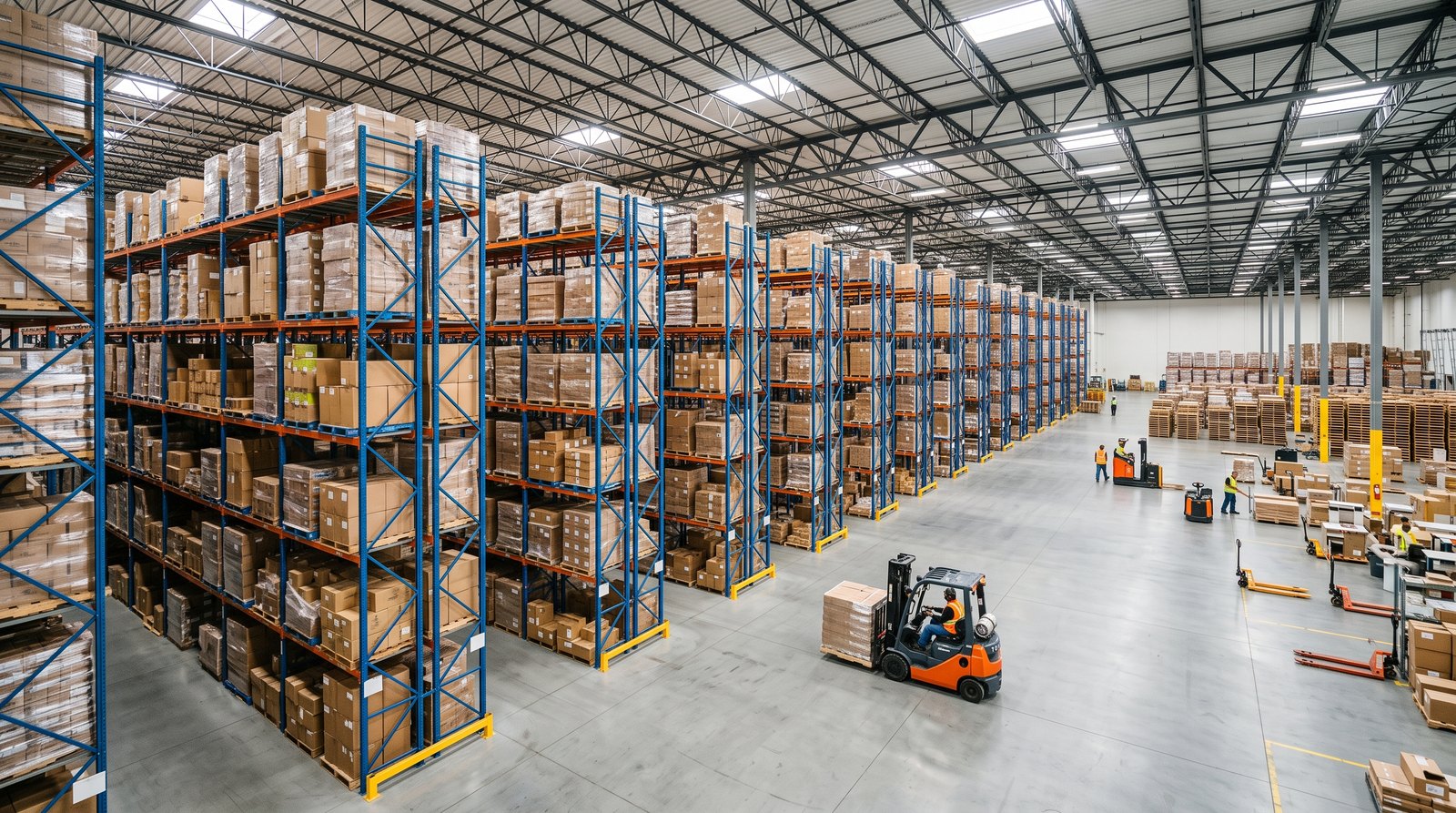
Warehouse storage is priced in different ways, but most models boil down to one idea: you’re paying for space and the work it takes to move goods in and out of that space. This guide explains the most common pricing models - especially per pallet position and per square foot - and how to choose the one that fits your inventory and turnover patterns.
If you’re mapping a complete Denver-area warehousing plan (storage, staging, transfers, and exception recovery), start here. Services
How is warehouse storage priced (in plain English)?
Most warehouses price storage based on how much space your inventory occupies over a billing period, plus separate fees for receiving, put-away, and outbound handling. The “right” model depends on whether your freight is uniform and palletized, irregular and floor-staged, or small-item inventory that lives in bins or shelving.
A quick way to avoid confusion is to separate your thinking into two buckets:
- Space fees (storage) - paying to reserve capacity
- Work fees (handling) - paying for labor/equipment to move product
What are the most common warehouse storage pricing models?
Warehouses tend to use one (or a mix) of these models because different freight behaves differently.
Per pallet position
Per-pallet pricing charges you based on how many pallet positions you occupy. It’s usually the simplest model when your freight is consistent - standard footprints, predictable stackability, and clear counts.
Use it when you can answer, “How many pallets are in storage?” without debate.
Per square foot (floor space)
Per-square-foot pricing charges you for the floor area you occupy. It’s often used when freight is oversized, non-stackable, irregular, or stored as floor-staged product rather than neatly racked pallets.
Use it when the true constraint is “How much floor does this take?” rather than “How many pallets is that?”
Per cubic foot (volume)
Cubic-foot pricing is volume-based. It’s common for mixed inventories where the warehouse is tracking dimensions and the actual volume used matters more than pallet count.
Use it when you store variable-sized units and want pricing aligned to volume.
Per bin / per SKU / per location
Bin- or SKU-based storage charges can be a better fit for small-item inventories that live in shelving or bins. Instead of pallet positions, you’re paying for the assigned storage “locations.”
Use it when your inventory is not truly pallet-driven and location management is the constraint.
Per pallet vs per square foot: which one is better for your inventory?
Per pallet is usually better when your freight is uniform, stackable, and turns regularly. Per square foot is usually better when the limiting factor is floor area - odd shapes, non-stackable product, or staged freight that can’t be efficiently racked.
Decision table: choose the pricing model that fits your reality
| Freight profile | Model that usually fits | Why it fits | Watch-outs | Question to ask |
|---|---|---|---|---|
| Standard 48x40 palletized freight with predictable stackability | Per pallet position | Simple counting and predictable capacity | If pallets are oversized or overhang, pricing may shift | How do you treat overhang, double-stacks, and non-standard pallets? |
| Oversized or non-stackable product (odd footprints, fragile, or floor-staged) | Per square foot | Floor area is the constraint | Aisles, access lanes, and safety clearance can increase true footprint | Is the billed square footage just product footprint or does it include access aisles? |
| Mixed sizes with variable packaging and frequent changes | Per cubic foot | Tracks volume used, not just positions | Requires accurate dimensions and consistent measurement rules | How do you measure volume and when do you snapshot it? |
| Small parts / high SKU count stored in bins or shelving | Per bin / per location | Storage location management is the constraint | Can get expensive if SKU proliferation is unmanaged | Is pricing per bin, per shelf, or per SKU - and what happens when we add SKUs? |
| High velocity (in/out frequently) with short dwell times | Per pallet + handling fees (combined view) | Storage may be low, handling becomes the real cost | A cheap storage rate can be offset by high handling | What are receiving, put-away, and outbound handling fees - and what triggers re-handling? |
What cost drivers can change your warehousing total even with the same pricing model?
Even if two warehouses both charge “per pallet,” your total can differ based on how your inventory behaves and how the warehouse needs to handle it.
Common drivers to pay attention to:
- Dwell time: slow movers accumulate storage cost over time
- Turn frequency: frequent in/out shifts cost from “space” to “labor”
- Inbound condition: mixed pallets, weak wrap, or unclear counts increase receiving effort
- Special handling: fragile goods, heavy units, or unusual footprints often require extra touches
- Storage method: racked vs floor-staged can change the effective space requirement
- Seasonality: volume spikes can create capacity constraints and operational complexity
How to read a warehouse invoice: storage fees vs handling fees (so you compare apples to apples)
A good comparison separates what you’re paying for space from what you’re paying for work. Many “cheap storage” quotes become expensive once you add receiving and outbound touches.
In most warehousing arrangements, you’ll see fees like:
- Storage (space reservation)
- Receiving / unload (getting product in)
- Put-away (moving into the storage location)
- Outbound pull / load (moving product out)
- Special services (labeling, rework, rewrap, sorting) when needed
If your operation is prone to exceptions - damaged pallets, shifted freight, or rejection issues - make sure you have a clear recovery path so the problem doesn’t turn into compounding storage + delay cost.
If your freight needs flexible storage and handling in the Denver area, review your warehousing options.
Checklist: the fastest way to sanity-check a storage quote
Use this checklist to avoid “surprise” totals when comparing pricing models.
- Confirm the unit of storage (pallet position, square foot, cubic foot, bin/location)
- Confirm the billing cadence (daily, weekly, monthly) and when snapshots are taken
- Confirm how the warehouse treats non-standard pallets, overhang, and mixed stacks
- Confirm what counts as a handling event (receiving, put-away, pull, reload)
- Ask what conditions trigger extra touches (re-stacking, re-wrap, recount)
- Confirm any minimum charges or volume commitments
- Confirm what documentation you must provide to avoid delays (counts, labels, PO/BOL details)
Two real-world scenarios: when each model wins
Scenario 1: Beverage distributor with steady turns (per pallet wins)
A distributor ships consistent palletized product and replenishes weekly. Counts are clean, pallets are uniform, and the biggest need is predictable capacity. A per-pallet-position model stays simple and forecastable because the inventory behaves like “countable blocks.”
Why it works: the warehouse’s capacity planning aligns to pallet positions, and billing stays predictable.
Scenario 2: Oversized building materials staged on the floor (per square foot wins)
A shipper stores irregular, non-stackable freight that can’t safely be racked. The real constraint is floor footprint plus access lanes for safe movement. A per-square-foot model better aligns to what the warehouse must reserve.
Why it works: pricing reflects the true space constraint instead of forcing awkward “pallet equivalents.”
Common mistakes and red flags when choosing a pricing model
Most warehousing pricing frustration comes from choosing a model that doesn’t match how your inventory behaves.
Common mistakes:
- Comparing storage rates without comparing handling fees
- Using per-pallet pricing for freight that’s oversized, non-stackable, or frequently re-handled
- Ignoring how snapshots work (a “monthly snapshot” can penalize slow movers if you don’t plan turns)
- Not clarifying how overhang, mixed pallets, or damaged pallets are billed
- Letting SKU counts grow without a storage-location plan
Red flags that predict a mismatch:
- You can’t reliably forecast pallet count or footprint
- Your freight routinely arrives unstable or needs rework before it can be stored safely
- Your business has big seasonal spikes and limited flexibility on delivery windows
Frequently Asked Questions
Is “per pallet” always cheaper than “per square foot”?
Not always. Per pallet can be cost-effective for uniform palletized freight, but it can become inefficient for oversized or floor-staged freight where footprint - not pallet count - is the real constraint.
Why do two warehouses quote the same model but different totals?
Because “the model” is only the unit. Total cost depends on dwell time, in/out frequency, handling requirements, and how many extra touches your freight requires.
What’s the best way to reduce warehousing cost without cutting service level?
Align the pricing model to your inventory reality, reduce unnecessary touches (clean labeling, stable pallets, correct counts), and design your inbound/outbound cadence to avoid excess dwell time.
Next step
If you want help choosing a warehousing approach that fits your inventory flow (and keeps invoices predictable), start with the service workflow.
< Older Post
Newer Post >
More in Pricing & accessorials
Keep reading in this cluster
How to Avoid Surprise Cross-Dock Fees: Scope Control, Quote Inputs, and a Simple Audit Workflow
Prevent surprise cross-docking add-ons with a scope-control playbook: what is included vs add-ons, a quote checklist, real scenarios, and a 5-step invoice audit workflow.
Layover vs Detention in Freight: What Triggers Each Charge (and How to Prevent Both)
Understand layover vs detention in trucking, when detention becomes layover, what proof matters, and practical checklists to prevent surprise time-based charges.
How to Avoid Detention Fees in Freight: A Dock-Side Playbook for Shippers, Receivers, and Brokers
Reduce detention fees with a practical dock-side prevention playbook: appointment inputs, dock packet checklist, scope control, and real scenarios.

Freight Rework Pricing Explained: Per Pallet vs Hourly vs Scope (and What Changes the Total)
Learn how freight rework is priced (per pallet, hourly, flat scope, hybrid), what drives total cost, and a quote checklist to avoid re-quotes.