
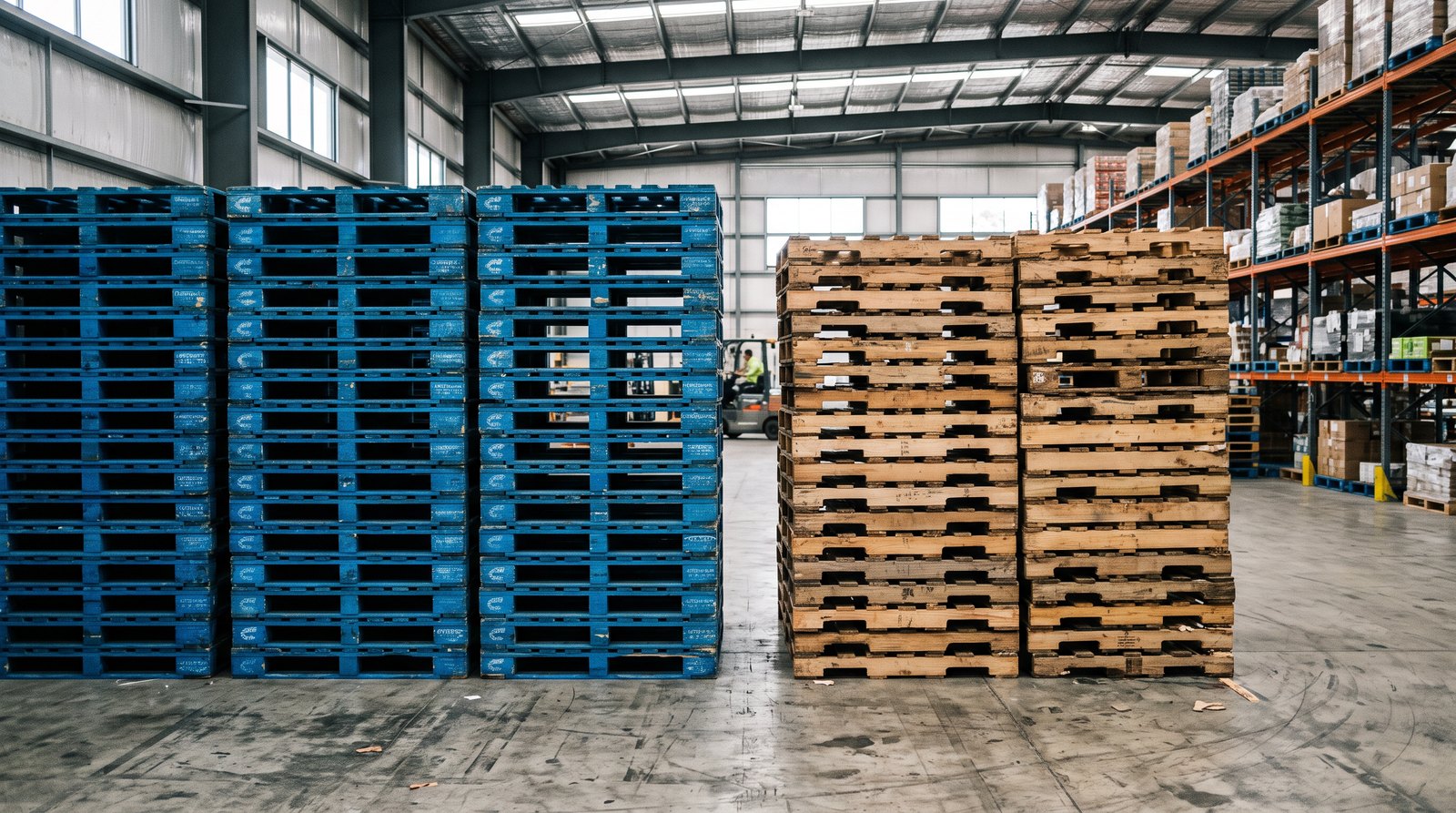
CHEP pallets (pooled/rented pallets) and “standard” pallets (typically purchased white-wood pallets) can both move freight reliably - but they create very different cost and control tradeoffs. This guide explains those tradeoffs in practical terms: what usually drives total cost, where hidden fees appear, and how to choose the safer option for your lane and customer mix.
If you want to align pallet choices with your overall handling and service workflow, start here.
What’s the difference between CHEP pallets and standard “white wood” pallets?
CHEP pallets are part of a pallet pooling (rental) system, where you pay to use pallets from a managed network and the provider handles inspection, repair, and circulation. Standard pallets are typically owned assets (new or recycled) that you buy, manage, repair, and replace as needed.
The key difference isn’t just color or construction - it’s who carries the operational burden. With ownership, you carry the burden (and the flexibility). With pooling, you trade some flexibility for a more standardized, managed pallet lifecycle.
Which option usually costs less: renting (pooling) or buying pallets?
Neither is “always cheaper.” Pooling can reduce capital outlay and simplify quality control, but it can become expensive if pallets sit too long (dwell time) or go missing (accountability fees). Buying can be cheaper per unit and gives you full control, but you absorb repair, sorting, disposal, and return logistics.
A clean way to decide is to compare total cost of use (pooling) versus total cost of ownership (buying): not just the pallet itself, but also what it takes to keep your operation moving without rejections, damage, or rework.
What costs should you compare besides the pallet itself?
The fastest way to make the right call is to compare the cost drivers that show up downstream - because that’s where “cheap pallets” become expensive.
Common cost drivers to compare:
- Quality consistency: How often do pallets arrive with broken boards, protruding nails, or warped decks?
- Operational friction: Time spent sorting, repairing, staging, and finding “good enough” pallets.
- Reverse logistics: Who pays for returns, repositioning empties, or exchange admin?
- Receiver requirements: Some facilities will reject loads that don’t meet their pallet policy.
- Damage + rework risk: Unstable or damaged pallets increase rewrap/repalletizing events.
- Accountability exposure: Pooling systems often require tighter tracking and proof of transfer.
Decision table: when pooling wins, when ownership wins, and when a hybrid is safer
Use this as a starting framework. You’ll still want to confirm receiver policies and your lane realities.
| Scenario | When pooled (CHEP) pallets fit | When standard pallets fit | Cost tradeoff to weigh |
|---|---|---|---|
| High-velocity shipments | Pallets turn quickly and are returned or declared promptly | Pallets churn quickly but you have strong internal QC and repair | Some customers require pooling; others don’t |
| Slow-moving inventory | Pallets don’t sit long in storage and don’t get stuck | Pallets may sit for weeks or months (storage-heavy) | You pool for fast lanes, own for slow lanes |
| Receiver compliance pressure | Receivers prefer or require pooled pallets for standardization | Receivers accept white-wood exchange without issue | You maintain both to meet mixed customer policies |
| Long-distance / one-way lanes | Recovery of owned pallets is difficult or uneconomical | You have a closed-loop where pallets come back reliably | Pooling for one-way, ownership for closed-loop |
| High pallet loss / leakage risk | You can prove transfers and manage asset accountability | You can absorb occasional loss without external fees | Pooling only where you can control custody |
| Freight damage sensitivity | Standardized pallets reduce unknown quality variation | You can enforce strict pallet grades internally | Pooling for fragile or high-value SKUs, ownership for the rest |
How do receiver requirements and automation change the decision?
Receiver requirements are often the hidden “kingmaker.” If a customer facility has strict pallet rules (size, construction style, or pooling preference), the cheapest pallet is the one that gets accepted without delays.
Automation can amplify this. Systems designed around consistent pallet specs tend to be less forgiving of irregular decks, loose fasteners, or inconsistent entry points. If your shipments routinely move through high-volume DCs, you should treat pallet choice as part of your risk management - not a commodity purchase.
How do pallet loss and dwell time turn pooling into a cost problem?
Pooling programs typically depend on you being able to return, transfer, or declare pallets within a defined process. Two situations raise costs quickly:
1) Dwell time: If rental pallets sit under slow-moving inventory, the “pay as you use” advantage erodes.
2) Loss/leakage: If pallets drift into places where you can’t get proof of transfer (small receivers, unpredictable returns, unclear custody), you may end up paying loss or correction fees.
If your network includes many small receivers, seasonal pop-up locations, or informal exchange practices, build your pallet strategy around how custody is actually managed - not how it’s supposed to work.
What size and compliance details can create hidden pallet costs?
Pallet size and compliance can cause surprise costs when they create rejection, rework, or export holds.
Size/compatibility: In North America, 48" x 40" is commonly treated as the “standard” footprint in many supply chains, but you should confirm what your customers and racking systems require. A practical reference for common sizes is here.
Export compliance (wood packaging): If you ship internationally using wood pallets, you may need ISPM 15-compliant (heat-treated/stamped) wood packaging. Reference documentation
Checklist: how to choose CHEP vs standard pallets for a specific lane
Use this checklist before you change a pallet program or bid a new customer.
- Confirm the receiver’s pallet policy (pooling required, exchange accepted, size requirements)
- Confirm whether the receiver requires block vs stringer style or specific entry constraints
- Confirm whether you have the correct pooling account/process (if renting)
- Estimate typical pallet dwell time (hours/days vs weeks)
- Map your custody chain (who controls pallets at each handoff)
- Decide how you’ll capture proof of transfer/return (if pooling)
- Estimate how often you deal with damaged/unstable pallets today
- Identify whether the lane has export requirements (ISPM 15)
- Confirm handling constraints (dock equipment, pallet jacks, racking tolerances)
- Define your “when it goes wrong” plan (rework, repalletize, rewrap)
If pallet quality or receiver requirements are causing load instability or rejections, having a clear rework option helps you recover quickly without derailing delivery schedules.
Two real-world scenarios: where the wrong pallet choice becomes expensive
Scenario 1: A retail DC rejects non-compliant pallets
A shipper uses inexpensive white-wood pallets to reduce upfront spend. At delivery, the retail DC enforces a strict pallet program and refuses the load until it’s reworked onto compliant pallets. The “cheap pallet” decision triggers a chain of costs: delivery disruption, additional handling, and repalletizing/re-wrapping.
What would have helped: confirming the receiver’s pallet policy before tender and using a pallet plan that matches that policy.
Scenario 2: Rental pallets sit under slow-moving inventory
A distributor switches everything to pooling pallets for simplicity. One product line moves slowly, and pallets sit in storage for extended periods. Over time, the rental model becomes harder to justify for that SKU family, especially when pallets aren’t circulating through a return network quickly.
What would have helped: a hybrid strategy - pooling for fast lanes, ownership for long dwell-time storage.
Common mistakes and red flags (the stuff that causes surprise bills)
Most pallet-program pain comes from mismatches between policy and reality.
Common mistakes:
- Choosing a pallet strategy without confirming receiver requirements
- Treating pallet pooling as “set and forget” (no tracking or transfer discipline)
- Using rental pallets where custody is unclear (many small receivers, irregular returns)
- Mixing pallet types in ways that confuse warehouse teams and increase handling errors
- Ignoring export requirements until freight is already staged
Red flags that suggest a hybrid approach:
- You serve both big DCs and small receivers with different pallet expectations
- Some SKUs move fast while others sit in storage for long periods
- You have frequent exceptions: rejected loads, unstable pallets, or repeat rewrap events
Frequently Asked Questions
Are CHEP pallets always the same size as “standard” pallets?
Not always. Many programs align to common footprints in specific regions, but sizes and specs can vary. Confirm the footprint your receiver requires and the program your pooling provider supplies.
Can I mix pooling pallets and owned pallets in the same operation?
Yes. Many operations use a hybrid approach - pooling where standardization is required or returns are hard, and ownership where dwell time is long or custody is controlled.
Will a receiver accept standard white-wood pallets?
Sometimes, but not always. Some facilities accept exchange pallets, while others have strict compliance rules. Confirm the policy before tender to avoid rejection and rework.
Where can I learn more about pallet pooling?
A starting reference for how pooling is framed by a pooling provider is here: CHEP
< Older Post
Newer Post >
More in Pricing & accessorials
Keep reading in this cluster

How to Avoid Surprise Cross-Dock Fees: Scope Control, Quote Inputs, and a Simple Audit Workflow
Prevent surprise cross-docking add-ons with a scope-control playbook: what is included vs add-ons, a quote checklist, real scenarios, and a 5-step invoice audit workflow.
Layover vs Detention in Freight: What Triggers Each Charge (and How to Prevent Both)
Understand layover vs detention in trucking, when detention becomes layover, what proof matters, and practical checklists to prevent surprise time-based charges.
How to Avoid Detention Fees in Freight: A Dock-Side Playbook for Shippers, Receivers, and Brokers
Reduce detention fees with a practical dock-side prevention playbook: appointment inputs, dock packet checklist, scope control, and real scenarios.

Freight Rework Pricing Explained: Per Pallet vs Hourly vs Scope (and What Changes the Total)
Learn how freight rework is priced (per pallet, hourly, flat scope, hybrid), what drives total cost, and a quote checklist to avoid re-quotes.